

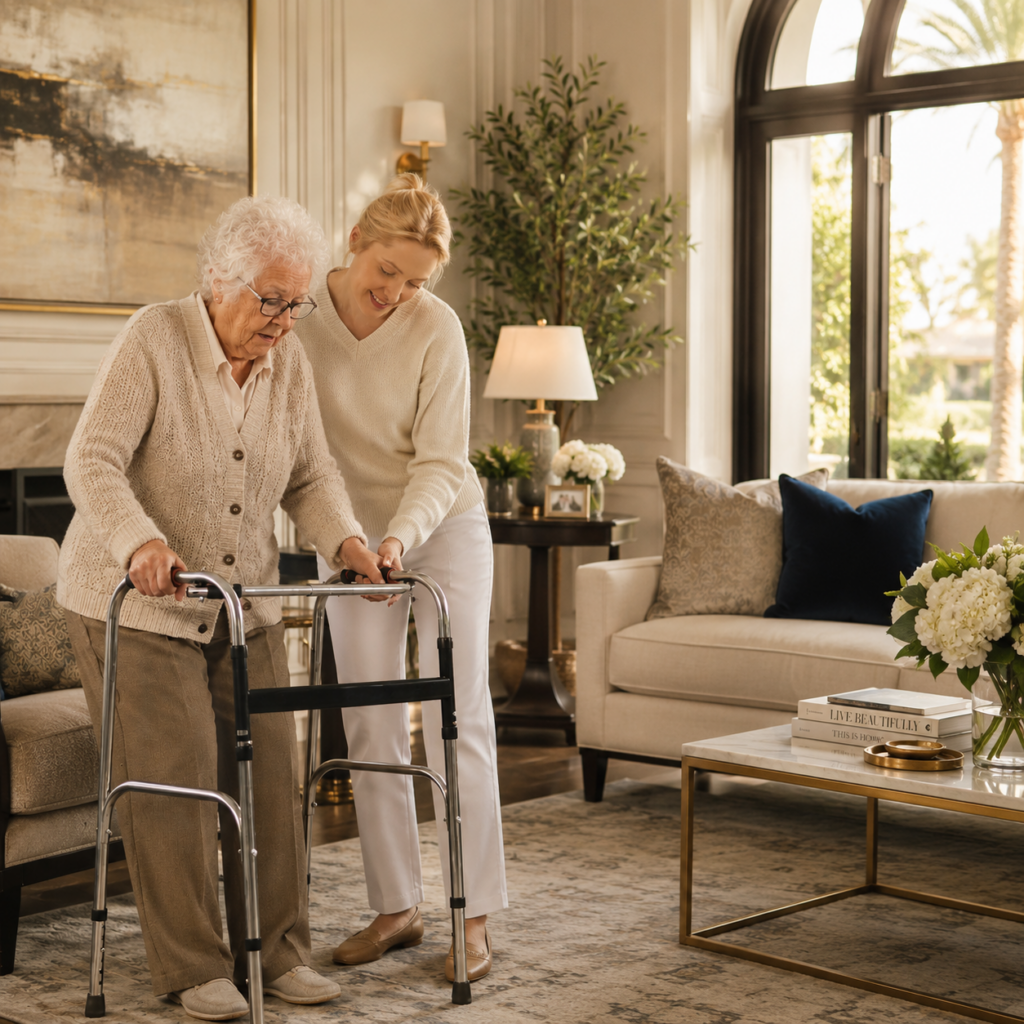
Fall prevention for seniors is one of the most important conversations families have with an aging parent, and June is the right time to have it. June is National Safety Month, and the first week (June 1 through 7) is National CPR and AED Awareness Week. This week also has the United Nations Global Day of Parents (June 1st), and safety is one simple way to honor parents.
Together, they frame a topic that families across Orange County and Palm Springs navigate every day: how to keep an aging parent safe at home without making the home feel like a hospital.
One in four adults over 65 falls each year. Falls are the leading cause of injury and injury-related death among older adults, and the fall-related death rate has climbed more than 50 percent over the past decade. Most senior falls happen at home. Most are preventable.
A fall-resistant home does not require a renovation. It requires a careful room-by-room walk-through, with eyes trained to see what a familiar resident no longer notices. Below is the home safety checklist that Newport Home Care uses when we begin care with a new client, broken down by the rooms where seniors most often fall.
Bathroom Safety: The Highest-Risk Room for Senior Falls
The bathroom is the highest-risk room in nearly every home. Wet floors, hard surfaces, low fixtures, and tight quarters combine to punish any moment of imbalance.
Bathroom fall prevention checklist:
- Grab bars beside the toilet and inside the shower or tub, anchored into wall studs (not screwed into drywall). A towel bar is not a grab bar.
- A non-slip mat or textured strips inside the tub or shower floor.
- A transfer bench or shower chair for clients who tire while standing.
- A raised toilet seat or a comfort-height toilet (17 to 19 inches) so the user does not have to lower all the way down.
- Bright, motion-activated lighting for nighttime trips. Overhead-only lighting casts shadows.
- Lever-style faucet handles are far easier for arthritic hands.
- Frequently used items (toothbrush, medication, towels) stored at counter or shoulder height.
Stair Safety: Where Senior Falls Become Serious
A fall on the stairs is rarely a minor one. For homes with even a few steps, the audit is essential.
Stair fall prevention checklist:
- Handrails on both sides of the stairway, secured into framing and extending the full length of the run.
- Stair treads with high-contrast, non-slip material, especially on the top and bottom steps, where depth perception is lost.
- Adequate lighting at the top and bottom of every staircase, with switches accessible from both ends.
- No runners, area rugs, or loose carpeting on or near the stairs.
- For two-story homes where the primary bedroom is upstairs, a stair lift is worth considering. The cost is far below the cost of a hip fracture.
- Single steps and sunken rooms marked with contrasting tape or paint. These transitions are missed more often than full staircases.
Kitchen Safety for Aging Adults
The kitchen combines reaching, lifting, working on hot surfaces, and walking on slippery floors in close quarters.
Kitchen safety checklist for seniors:
- The most-used items (plates, pans, coffee, mugs) are stored between hip and shoulder height. No reaching overhead, no bending low.
- A stable step stool with a handrail for higher shelves, and a household rule that it is only used with another adult at home.
- Non-slip flooring, or area rugs, only if they are rubber-backed and lie completely flat.
- Spills are wiped immediately. A schedule for floor cleaning that does not leave water sitting on tile.
- Lever-style cabinet pulls instead of small round knobs.
- Stove safety features: an automatic shut-off device, or for clients with memory concerns, an induction cooktop that does not stay hot after use.
Bedroom Safety and Nighttime Falls
A significant share of senior falls happen during the overnight trip from bed to bathroom.
Bedroom fall prevention checklist:
- A clear, lit path from the bed to the bathroom. Motion-activated nightlights along the route, low enough to illuminate the floor without glare.
- A bed at the right height. When seated on the edge, the user’s feet should rest flat on the floor with knees at roughly 90 degrees.
- A sturdy nightstand within easy reach, holding a phone, flashlight, water, and any required medication.
- Throw rugs removed or anchored with rug tape. A bunched rug at the bedside is a fall waiting to happen.
- A bedside lamp with a cord that does not cross the path from bed to door.
- For high-risk clients, a bed rail or floor-level fall mat.
Hallway, Walkway, and Outdoor Safety for Older Adults
The connecting spaces of the home receive less attention than the rooms themselves, and they deserve more.
Hallway and walkway safety checklist:
- Every throw rug, runner, and decorative carpet is evaluated for whether it earns its place. The default answer is no.
- Cords are routed against walls, never across walking paths.
- Even flooring with consistent transitions. Where carpet meets tile, or wood meets stone, the threshold should be flush.
- Outdoor walkways with handrails, even pavement, and pathway lighting that activates at dusk.
- A bench inside the front door for sitting while removing shoes. Balancing on one foot to take off a shoe causes more falls than most families realize.
- Pets, especially small dogs, are taken into account in the layout. A dog underfoot is a leading cause of fall injuries among older adults.
Why CPR and AED Awareness Matter in Fall Prevention
National CPR and AED Awareness Week runs the first week of June for a reason. Falls and cardiac events often occur together. A cardiac arrhythmia can cause a fall. A hard fall can trigger a cardiac event. In either case, the first few minutes determine the outcome.
Every adult living with or regularly visiting an aging parent should know basic CPR. Every professional caregiver placed in the home should hold a current Basic Life Support certification and have credentials on file with the agency. For high-risk clients, a home AED is a reasonable conversation to have with the treating cardiologist. The American Heart Association offers in-person and hybrid certification courses across Newport Beach, Costa Mesa, and Irvine.
When to Schedule a Professional Home Safety Assessment
A family member walking through an aging parent’s home will miss things. Not because they are careless, but because they have walked past those things a thousand times. The lamp cord is by the bed. The rug at the front door. The cabinet that has always been a stretch to reach. Familiarity hides risk.
A professional in-home safety assessment is different. Newport Home Care’s care coordinators evaluate the home with eyes that have never seen it before, and with training in the specific risk factors that make senior falls more likely: medications that affect balance, vision and hearing changes, cognitive shifts, and mobility patterns that have evolved gradually enough that no one in the family has noticed. From that walk-through, we build a care plan that adjusts as the client’s needs change.
Frequently Asked Questions About Senior Fall Prevention
What is the most common cause of falls in seniors? Loss of balance, muscle weakness, medication side effects, and home hazards are the leading causes. Most senior falls occur at home and involve a combination of personal risk factors and an environmental trigger, such as a throw rug, poor lighting, or a wet floor.
Which room is the most dangerous for senior falls? The bathroom. Wet surfaces, low fixtures, and tight quarters make it the single highest-risk room in the home. Grab bars, non-slip surfaces, and a transfer bench substantially reduce that risk.
How often should a home safety assessment be done for an aging parent? At least once a year, and any time there is a change in health, mobility, or medication. A new diagnosis, a hospitalization, or a new prescription is a reason to schedule a fresh walk-through.
Does Medicare pay for in-home fall prevention services? Standard Medicare does not cover most non-medical in-home care. Some Medicare Advantage plans, long-term care insurance, and VA benefits cover portions. Newport Home Care can walk families through what their specific plan covers during the initial assessment.
Taking the Next Step in Fall Prevention
Creating a fall-resistant environment for an aging parent is one of the most proactive steps a family can take. While this room-by-room checklist provides a strong foundation, familiarity with a home often leads family members to overlook subtle yet significant risks. If you are navigating vision changes, new medications, or evolving mobility concerns, professional guidance can offer a crucial layer of safety. Newport Home Care’s care coordinators are trained to create a comprehensive care plan that evolves as your loved one’s needs change.
Secure Your Peace of Mind Today
Don’t wait for a fall to happen. If you are ready to discuss how professional in-home support can enhance your parents’ safety and quality of life in Newport Beach or anywhere in Orange County, reach out to Newport Home Care. Start the conversation this National Safety Month to secure a safer, more confident future for your loved one.
Phone: (949) 814-7307 and Web: www.newportcare.com
Call Newport Home Care today to begin the conversation.